PLC Transformers vs. Traditional Communication Transformers: Key Differences for Modern Applications
Magnetic components used for data transmission are not interchangeable simply because they share the word “transformer” in their name. A component designed to carry data over a dedicated network cable operates under different conditions than one designed to carry data signals over an electrical power line. Understanding these differences matters when engineers are deciding which type of transformer belongs in a given design.
This article compares the PLC transformer with the traditional communication transformer commonly used in local area network (LAN) equipment, looking at how they differ in signal transmission method, operating environment, typical application systems, and the design requirements each one involves.
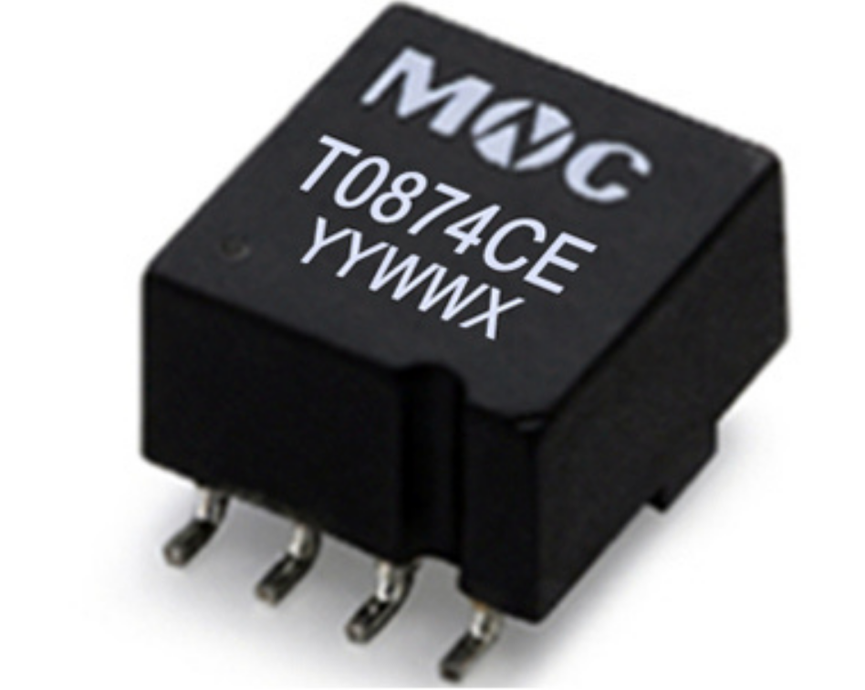
Different Transmission Media, Different Roles
A traditional communication transformer, often referred to as a LAN transformer, is built to shape and isolate data signals traveling over dedicated network cabling, such as Ethernet lines. Its job is to support the physical layer of a network connection, keeping signal integrity intact as data moves between a network interface and the cable.
A plc transformer, by contrast, is designed to couple communication signals directly onto a power line. Rather than working alongside a separate data cable, it shares the same conductor pathway as electrical power. This distinction is the starting point for most of the other differences between the two component types.
Signal Isolation and Voltage Handling
Because a LAN transformer typically sits between a network cable and sensitive networking hardware, its isolation requirements are shaped by cable-side surge events. Mentech’s traditional LAN transformer line, for example, is built to comply with IEEE 802.3 and ANSI X3.263 standards and offers isolation surge protection up to 6KV for HDBaseT-compatible applications, which reflects the kind of surge exposure network cabling can experience.
A PLC transformer, on the other hand, deals with isolation requirements tied to the power line itself rather than a network cable. Its HI-POT isolation rating is generally selected to match the voltage levels present on the power circuit it couples with. Mentech’s PLC transformer series, for instance, spans HI-POT ratings from 500V to 3750V, a range oriented around power-line voltage conditions rather than network cable surge events.
Data Rate and Protocol Alignment
Traditional LAN transformers are generally built around recognized Ethernet standards. Mentech‘s traditional LAN transformer products, for example, support transfer speeds across 10/100/1000M BASE-T as well as 2.5G, 5G, and 10G BASE-T configurations, aligning with IEEE 802.3 network standards used in switches, routers, and similar equipment.
PLC transformers are not built around Ethernet standards in the same way. Instead, their performance is typically matched to the requirements of a specific power line communication protocol, which may vary depending on the region and the application, such as narrowband systems used for smart metering or broadband systems used for higher-throughput power line networking. As a result, the relevant technical reference point for a PLC transformer is usually the power line communication standard in use, not an Ethernet data rate classification.
Power Delivery Considerations
Power over Ethernet (PoE) is a feature associated with some traditional LAN transformers, where power is delivered alongside data over the same network cable to devices such as IP cameras or wireless access points. Mentech’s traditional LAN transformer offerings include models supporting POE applications up to 150W, in addition to variants without POE functionality.
This is a distinct concept from what a PLC transformer does. A PLC transformer is not delivering auxiliary power to a downstream device through a data cable; it is coupling a communication signal onto a power line that is already carrying electrical current for its primary purpose. The two components solve different problems, even though both involve a relationship between power and signal.
Typical Application Systems
Traditional LAN transformers are commonly found in networking equipment such as switches, routers, and industrial Ethernet devices, as well as automotive networking applications where dedicated data cabling is used. Their design requirements are shaped by the need to maintain compliance with established Ethernet standards across a range of data rates.
PLC transformers appear in a different set of systems, including smart grid infrastructure connecting meters to utility control centers, smart home devices that exchange data and power over household wiring, and electric vehicle charging equipment that communicates over the charging cable. These applications share a common characteristic: data and power coexist on the same physical medium, which is the scenario a PLC transformer is built to support.
Mounting and Mechanical Considerations
Both component categories are generally available in Surface Mount Technology (SMT) and Dual In-line Package (DIP) formats, giving design teams flexibility depending on their assembly process. This is one area where the two categories share more similarity than difference, since mounting format is largely a manufacturing and integration consideration rather than one tied to the underlying signal transmission method.
Choosing Between the Two for a Design
Deciding between a PLC transformer and a traditional communication transformer generally comes down to the transmission medium the design relies on. A system built around dedicated network cabling and Ethernet-based data rates points toward a traditional LAN transformer, particularly when POE support or compliance with IEEE 802.3 standards is required. A system where communication signals travel over an existing power line points toward a PLC transformer, particularly when isolation from AC or DC voltage levels is a central design requirement.
Mentech, a transformer and inductor manufacturer based in China, produces both PLC transformer and traditional LAN transformer product lines, along with other telecom and power magnetic components. Reviewing the specific datasheet for a given part number remains the most direct way to confirm whether a component’s isolation rating, data rate support, or mounting format aligns with a particular design’s requirements, regardless of which transformer category is under consideration.